Quick Answer
Yes. Neck problems can cause headaches. These are known as cervicogenic headaches.
With a cervicogenic headache, the source of the problem involves structures in the cervical spine—the neck—but the pain is perceived in the head.
In other words, the place where you feel the headache isn’t necessarily where the problem began.
After more than 22 years of caring for patients with headaches, one of the comments we hear most often is:
“I never knew my neck could have anything to do with my headaches.”
For some people, that connection can be an important piece of the puzzle.
However, not every headache comes from the neck. Migraines, tension-type headaches, cervicogenic headaches, and other headache disorders can overlap in their symptoms.
Therefore, determining the type of headache—and whether the neck is actually contributing—requires more than simply asking where it hurts.
It starts with your history and a thorough examination.
 What Is a Cervicogenic Headache?
The word sounds complicated, but the concept is fairly straightforward.
Cervico refers to the cervical spine, or neck.
Genic essentially means originating from.
Therefore, a cervicogenic headache is a headache associated with a problem originating in structures of the neck.
The International Classification of Headache Disorders describes cervicogenic headache as a headache caused by a disorder involving the cervical spine and its bony, disc, or soft-tissue structures. Neck pain is often present; however, it doesn’t have to be.
That’s important because you can experience pain in your head even though the contributing problem involves your neck.
How Can a Problem in the Neck Be Felt in the Head?
This is where the nervous system becomes important.
The upper cervical spine contains joints, muscles, ligaments, and nerves that communicate closely with neurological pathways involved in sensation from the head and neck.
Because these pathways interact, irritation or dysfunction involving structures in the neck can sometimes be experienced as pain somewhere else.
This is known as referred pain.
Most people already understand referred pain without realizing it. For example, the place where you feel a symptom isn’t always the place where that symptom originated.
Cervicogenic headaches are one example of that relationship.
For this reason, simply chasing the location of the pain doesn’t always tell us the entire story.
Instead, we want to understand why the headache is happening.
What Does a Cervicogenic Headache Feel Like?
There isn’t one symptom that automatically tells us someone has a cervicogenic headache.
However, certain patterns may make us investigate the neck more closely.
Someone may notice:
- Headache accompanied by neck discomfort or stiffness
- Reduced neck movement
- Headaches that seem to worsen with certain neck movements or positions
- Headaches associated with prolonged computer work or sustained posture
- Pain that seems to begin around the neck or base of the skull and travel into the head
- Headaches associated with previous neck injuries
In addition, some people describe shoulder tightness or restricted movement along with their headaches.
Even so, symptoms alone don’t establish the cause.
That’s an important distinction because having neck pain and headaches at the same time doesn’t automatically mean the neck is causing the headache.
Instead, the goal of an appropriate evaluation is to determine whether there is evidence connecting the two.
Could an Old Injury Be Contributing?
This is one reason we ask patients about their entire history rather than only asking about today’s headache.
We want to know:
When did your headaches first begin?
Was it after a car accident?
A sports injury?
A fall?
Years of working behind a computer?
Did the headaches slowly become more frequent?
Was there an injury years ago that you haven’t thought about in a long time?
Sometimes patients tell us:
“That accident happened 15 years ago. I didn’t think it mattered anymore.”
Maybe it does.
Maybe it doesn’t.
Either way, that’s why we ask.
An old injury should never automatically be blamed for a current headache. Nevertheless, understanding previous trauma and how symptoms developed over time can provide valuable information during the examination.
Every headache has a story.
Our job is to understand yours.
 What About Posture and Computer Work?
Modern life places some unique physical demands on the neck.
For example, many of us spend hours every day:
Looking at computers.
Looking down at phones.
Driving.
Sitting in meetings.
Working from laptops.
Repeatedly performing the same movements at work.
Over time, prolonged positions and repetitive physical demands can influence muscle tension, mobility, and how comfortably the neck functions.
That doesn’t mean “bad posture” automatically causes headaches. After all, human bodies are far more complicated than that.
Nevertheless, posture, work habits, movement, previous injuries, sleep, physical activity, and other stresses can all be pieces worth evaluating when someone experiences recurring headaches.
This is why we don’t simply ask:
“Where does it hurt?”
Instead, we ask:
“What has your body been adapting to?”
How Do We Determine Whether Your Neck Is Involved?
At Chandler Chiropractic, we don’t assume a headache is coming from the neck simply because someone walked into a chiropractic office.
Instead, we investigate.
Your consultation may include questions about:
- When your headaches began
- Headache frequency and duration
- Where the pain occurs
- Neck pain or stiffness
- What makes the headache better or worse
- Previous accidents and injuries
- Work and computer use
- Exercise
- Sleep
- Daily activities
- Other symptoms you’re experiencing
After the consultation comes the physical examination.
Depending on your individual situation, we may evaluate your:
Posture
First, we look at how you’re carrying your head, shoulders, and body.
Cervical range of motion
Next, we assess how well your neck moves in different directions and whether certain movements reproduce or influence your symptoms.
Muscle function
We may also look for differences in strength, tension, balance, or function.
Spinal mobility
In addition, we evaluate how different areas of the spine are moving.
Neurological function
When appropriate, neurological testing gives us additional information about how the nervous system is functioning.
Orthopedic findings
Specific tests may help us better understand what structures could be involved.
Balance
Finally, when your symptoms or history indicate that balance testing is appropriate, we may include it as part of the examination.
No single test gives us the entire answer.
Instead, think of it like putting together a puzzle.
The more meaningful pieces we gather, the clearer the picture becomes.

chiropractic adjustment for mid back pain
Why Do We Examine More Than Just the Neck?
This surprises some patients.
If the headache may be coming from the neck, why examine the rest of the spine?
One analogy I frequently use is a dental examination.
A dentist wouldn’t look at one tooth and ignore the rest of your mouth. Instead, they examine the entire area before making recommendations.
We believe the same principle applies to the spine.
The body functions as a connected system. Therefore, the area where someone experiences symptoms isn’t necessarily the only area we need to understand.
That’s why our examinations are personalized to the individual rather than built around a single symptom.
Will I Need X-Rays?
Not necessarily.
We don’t believe every patient experiencing headaches automatically needs X-rays.
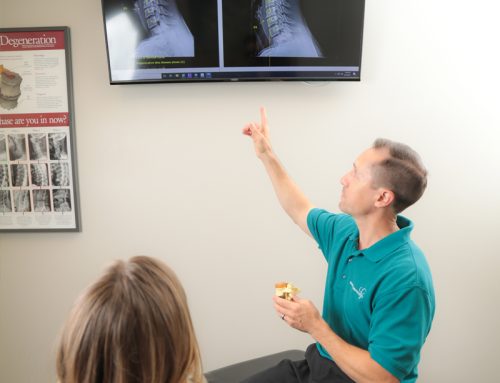
However, when digital X-rays are clinically appropriate, they can provide additional information about the structure of the spine, alignment and natural spinal curves, signs of degeneration, and evidence of certain previous injuries or other findings.
Even then, X-rays are only one piece of information.
They don’t diagnose every cause of headache, and an X-ray finding by itself doesn’t prove that something seen on the image is causing your headache.
Instead, when imaging is appropriate, we consider those findings together with your history and physical examination.
That approach helps us make safer, better-informed recommendations.
What Does the Research Say?
Cervicogenic headache is one of the headache categories for which manual therapy and spinal manipulation have been studied extensively.
For example, a 2020 systematic review and meta-analysis examined seven randomized clinical trials of spinal manipulative therapy for cervicogenic headache. Researchers found small short-term improvements in headache intensity, headache frequency, and disability compared with other manual therapies.
Importantly, the authors also noted limitations in the quality of the available evidence. Furthermore, significant long-term benefits were not established.
A larger 2022 systematic review and meta-analysis examined 20 studies involving more than 1,400 people. Manual therapy and exercise approaches—including spinal manipulation, mobilization, and specific exercises—showed improvements in several headache outcomes, although the strength of the results varied according to study quality.
More recent research continues to support the potential role of conservative, multimodal approaches. At the same time, it emphasizes that the certainty of evidence varies.
In other words:
The research is encouraging, but it doesn’t tell us that every person with headaches needs their neck adjusted.
That’s not how we interpret evidence.
Research gives us information. Your examination, however, helps us determine whether that information applies to you.
How Might Chiropractic Care Help When the Neck Is Involved?
When examination findings suggest that mechanical factors involving the neck may be contributing to someone’s headaches, chiropractic care may be one part of a conservative approach.
Depending on the individual, recommendations may focus on areas such as:
- Improving spinal and joint movement
- Addressing restricted neck mobility
- Supporting better overall function
- Exercise and rehabilitation
- Soft-tissue or massage therapy when appropriate
- Posture and workstation considerations
- Daily movement and activity
- Other lifestyle factors that may be contributing
The goal isn’t simply to “crack your neck.”
Likewise, it isn’t to chase a headache every time one appears.
Instead, our goal is to understand what may be contributing to the problem and recommend an appropriate plan based on what we find.
What If My Headache Isn’t Coming From My Neck?
Then we want to know that too.
Sometimes chiropractic care is an appropriate option. Sometimes it isn’t. In other cases, we need additional information before making that decision.
If your history or examination indicates that advanced imaging, medical evaluation, or another healthcare specialist should become involved, we’ll explain why and help guide you toward the appropriate next step.
Over the years, we’ve worked alongside neurologists, primary care physicians, orthopedic specialists, physical therapists, pain management specialists, imaging centers, and other healthcare professionals throughout the Valley.
Healthcare isn’t a competition.
It’s a team effort.
Above all, our loyalty is always to the patient—not to a particular type of care.
When Does a Headache Need Immediate Medical Attention?
Some headaches should not begin with a chiropractic evaluation.
Instead, seek immediate medical attention for symptoms such as:
- A sudden, extremely severe headache unlike anything you’ve experienced before
- Sudden vision loss or significant changes in vision
- Difficulty speaking or understanding speech
- Sudden weakness or numbness, particularly on one side
- Confusion or changes in mental status
- Loss of consciousness or feeling as though you may pass out
- Severe headache accompanied by high fever, stiff neck, or persistent vomiting
- Other symptoms suggesting a medical emergency
Your safety always comes first.
So, Is Your Neck Causing Your Headaches?
Maybe.
And that’s an answer we’re comfortable giving.
Headaches can have many different causes. Some originate from structures in the neck, while others don’t.
For that reason, we don’t believe the right first question is:
“Can you adjust my headache?”
The better question is:
“Why am I getting these headaches?”
After more than 22 years of caring for patients, I’ve learned that people aren’t simply looking for temporary answers.
They want to understand what’s happening.
They want someone to listen.
They want someone to investigate.
They also want recommendations based on their individual situation.
At Chandler Chiropractic, that’s where we begin.
Not with an adjustment.
With a conversation.
Because every headache has a story.
And understanding that story may be the first step toward Lasting Results for All Stages of Life.
Research & References
International Headache Society. International Classification of Headache Disorders, 3rd Edition (ICHD-3): Cervicogenic Headache.
Fernandez M, et al. Spinal manipulation for the management of cervicogenic headache: a systematic review and meta-analysis. European Journal of Pain. 2020;24(9):1687–1702.
Bini P, et al. The effectiveness of manual and exercise therapy on headache intensity and frequency among patients with cervicogenic headache: a systematic review and meta-analysis. Chiropractic & Manual Therapies. 2022.
Additional research continues to evaluate manual therapy, exercise, and multimodal conservative approaches for cervicogenic headache.
This article is intended for educational purposes and does not diagnose an individual condition. Headaches have many possible causes. New, severe, changing, or otherwise concerning headaches should receive appropriate medical evaluation.