Quick Answer
 A chiropractor evaluating an athlete after a concussion should do more than check for neck pain.
At Chandler Chiropractic, we want to understand what happened during the injury, what changed afterward, and how the athlete is functioning now.
For that reason, we evaluate the cervical spine and the neuromusculoskeletal system. We also look at strength, range of motion, posture, balance, gait, coordination, eye tracking, and appropriate neurological and orthopedic findings.
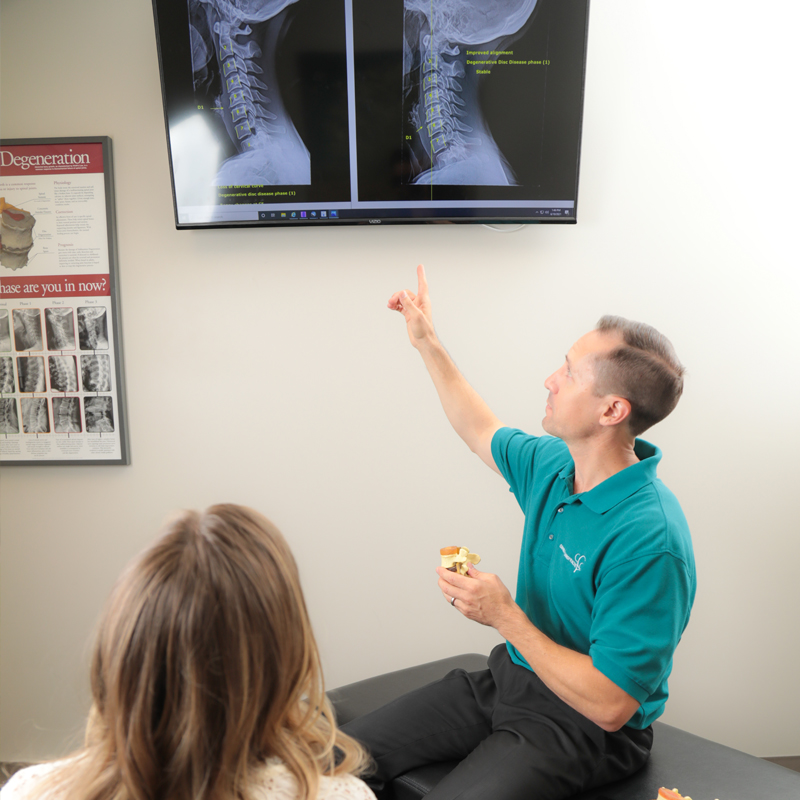
When clinically appropriate, we may also use digital X-rays to evaluate the cervical spine. These images can help identify structural findings that may affect our recommendations.
Why is this level of detail important?
A concussion is a brain injury. However, the forces involved can also affect the neck, joints, muscles, balance, coordination, and movement systems.
As a result, an athlete may experience headaches, dizziness, neck pain, restricted movement, balance problems, or difficulty returning to normal activities and sports.
Don’t think brain OR neck. Think brain AND neck.
A thorough chiropractic examination helps us identify the areas we may be able to address. It also helps us determine whether chiropractic care is appropriate, monitor progress, and recognize when another healthcare professional should be involved.
The First Question Isn’t “Where Should We Adjust?”
One common misconception is that an athlete comes into the office, reports a concussion, and immediately receives an adjustment.
That is not how we approach these injuries.
My first question is not:
“Where should I adjust?”
Instead, it is:
“What happened?”
After more than 22 years in practice, I’ve learned that the injury mechanism can provide valuable information.
For example, a football player who takes a helmet to the side of the head may experience different forces than a gymnast who falls backward from a beam.
Likewise, a soccer player involved in a head-to-head collision may have a different injury pattern from an athlete who gets hit, spins, falls, and strikes the ground.
Because of these differences, the examination begins before we touch the athlete.
It begins with their story.
Every Concussion Has a Story
First, I want to understand exactly what happened.
Whenever possible, we ask the athlete and parent to describe the event together.
Questions may include:
- What sport were you playing?
- What exactly happened?
- Where were you hit?
- What direction did the force come from?
- Did your head strike another player, equipment, or the ground?
- Did you experience a second impact when you fell?
- Did you lose consciousness?
- Were you confused?
- Do you remember the entire event?
- Could you walk normally afterward?
- Did you immediately develop a headache or dizziness?
- Did your vision change?
- Did you have neck or back pain?
- Did you continue playing?
- When did the symptoms begin?
Next, we look at what happened after the injury.
That information can be just as important.
The Question I Want Parents Asking: “What Changed?”
Parents know their children better than anyone.
Therefore, they are often the first to notice when something feels different.
After a concussion, families commonly watch for headaches and dizziness. Those symptoms matter, but they do not tell the entire story.
I also want to know:
What changed?
How is the athlete sleeping?
Are they sleeping more or less than usual?
Are they unusually tired?
Has their mood changed?
Are they irritable?
Are they quieter than normal?
Has their appetite changed?
Are they struggling to concentrate?
Is homework taking longer?
Have their grades or classroom performance changed?
Are they having trouble remembering things?
Do they feel unsteady?
Are they having difficulty walking?
Do they have neck pain, back pain, or shoulder pain?
Are they experiencing numbness or tingling?
Are lights or sounds bothering them?
Do their eyes feel different?
Do they become dizzy when moving their head?
Can they exercise?
Can they complete normal daily activities?
Sometimes the most important concussion symptom is simply: “This isn’t my child.”
That observation matters. It becomes another important piece of information during the examination.
Why the Chiropractic Examination Matters
 After hearing the athlete’s story, we begin evaluating function.
This is where chiropractic may provide valuable information to the concussion recovery team.
A concussion diagnosis tells us that the brain experienced an injury. However, we also want to understand how the rest of the athlete responded to the event.
What happened to the rest of the athlete during the injury?
For example:
- How is the neck moving?
- How are the joints functioning?
- Are the muscles working normally?
- Is the athlete equally strong on both sides?
- Has posture changed?
- How is their balance?
- How are they walking?
- How are their eyes tracking?
- How is their coordination?
- Can they accurately sense where their head and body are in space?
These details help us understand whether the athlete’s cervical and neuromusculoskeletal systems are functioning normally after the injury.
Evaluating the Cervical Spine
The neck is a major focus of our examination.
It should not be treated as an afterthought following a concussion. The same forces that rapidly accelerate, decelerate, or rotate the head can also place significant stress on the cervical spine.
Therefore, we may evaluate:
- Cervical range of motion
- Joint movement
- Areas of restriction
- Muscular tightness
- Tenderness
- Strength
- Left-to-right differences
- Head position
- Posture
- Neurological findings
- Orthopedic findings
We also palpate the cervical spine and assess how individual areas are moving and functioning.
The goal is to identify objective findings that may help explain what the athlete is experiencing.
The absence of neck pain does not automatically mean the neck is functioning normally.
That distinction is important.
An athlete may say their neck feels “fine.” However, the examination may still reveal restricted movement, muscular differences, tenderness, postural changes, or other findings that deserve attention.
For that reason, we examine instead of making assumptions.
Why the Neck Can Affect More Than the Neck
The cervical spine is more than a stack of bones supporting the head.
The muscles, joints, and sensory receptors in the neck provide the nervous system with information about head position and movement.
That information works with visual and vestibular input to help the body maintain orientation, balance, coordination, and movement.
After a concussion-producing impact, these systems may be affected at the same time. As a result, symptoms can overlap.
An athlete with cervical dysfunction may not simply say:
“My neck hurts.”
They may also experience headaches, dizziness, movement problems, or balance-related complaints.
Therefore, when an athlete continues to struggle after a concussion, we do not want to ignore the cervical spine simply because everyone is focused on the brain.
The brain matters. The neck matters. Function matters.
Muscle Strength Can Tell Us Part of the Story
When appropriate, muscle testing is another part of the examination.
We are not only asking whether an athlete is generally “strong.” Instead, we may compare one side of the body with the other and look for differences in muscular function.
This matters because athletes depend on coordinated neuromuscular control.
Running, cutting, jumping, landing, throwing, catching, tumbling, and reacting all require the brain and body to process information and produce controlled movement.
If the athlete demonstrates meaningful differences during the examination, we document them. Later, we can reevaluate those findings and look for improvement.
Care should produce information—not just appointments.
If we are helping an athlete recover, I want objective evidence that their function is changing.
Why We Evaluate Balance
Balance is especially important after a concussion.
A young athlete may feel relatively normal while sitting in a chair. However, a balance task may reveal problems that are not obvious during conversation.
Depending on the athlete’s situation, we may use clinical balance assessments, heel-to-toe walking, stepping tests, or other appropriate methods to evaluate postural control.
We may ask:
- Is the athlete stable?
- Do they drift?
- Does one side behave differently?
- Can they maintain control?
- How does their performance compare with what we would expect?
- Does their performance improve as they recover?
Does it improve as the athlete recovers?
Balance is not simply about whether someone falls over. Instead, it reflects the interaction of several systems involved in controlling the body.
For an athlete returning to a fast-moving sport, that information matters.
Why We Look at the Eyes
Parents are sometimes surprised when a chiropractor evaluates eye movement after a concussion.
However, eye movement can provide useful information about how an athlete is functioning.
Depending on the situation, we may observe:
- Eye tracking
- Smooth pursuit of a moving target
- Symmetry
- Pupil responses
- Whether eye movement provokes symptoms
- Other findings that suggest additional evaluation may be appropriate
This does not mean we are claiming to perform every specialized vestibular, neurological, or ophthalmological test.
Instead, we are gathering information.
If something does not look right, it may indicate that the athlete needs further evaluation from another healthcare professional.
Again:
The goal isn’t to do everything. The goal is to identify what the athlete needs.
We Look at Posture and the Entire Athlete
We do not examine the athlete as if they were only a head and neck.
Instead, we look at the entire person standing in front of us.
For example:
- Is the head tilted?
- Is there forward head posture?
- Are the shoulders level?
- Are the hips level?
- Does the athlete shift their weight?
- Is one side behaving differently from the other?
- How do they walk?
- How do they move?
- Does movement reproduce symptoms?
A concussion occurs during a physical event. Therefore, the physical consequences of that event deserve a physical examination.
What Role Do Digital X-Rays Play?
At Chandler Chiropractic, we have digital X-ray capabilities in our office.
However, an important distinction must be made:
X-rays do not diagnose concussion.
When clinically appropriate, cervical X-rays help us evaluate the cervical spine.
Depending on the circumstances, X-rays may provide information about bony structures, alignment, spinal curves, degeneration, previous injury, or other findings that could affect whether and how chiropractic care is provided.
Imaging can also reveal something that changes the entire plan.
For example, if we suspect a fracture, significant structural concern, instability, or another condition requiring additional evaluation, we do not simply proceed with an adjustment.
We stop.
We investigate.
We refer when necessary.
A thorough examination isn’t something that slows care down. It helps us choose the right care.
What If Something Doesn’t Look Right?
This is another reason I want chiropractors involved early.
A good chiropractor needs to know both:
When to provide chiropractic care—and when not to.
If the athlete’s history or examination raises concern for something outside our scope, we refer.
That referral could involve emergency medicine, sports medicine, neurology, orthopedics, physical therapy, vestibular rehabilitation, advanced imaging, or another appropriate provider.
Healthcare should not be a turf war.
If my examination indicates that someone else needs to be involved, I want them involved.
At the same time, if the examination identifies cervical and neuromusculoskeletal findings that are appropriate for chiropractic care, I do not want those findings ignored.
That’s our part of the recovery—and we get to work on it.
What Happens After the Examination?
After the examination, we use the information to guide the next steps.
We are not collecting findings simply to create a long examination. Instead, we are trying to answer several important questions:
Is chiropractic care appropriate?
What findings need to be addressed?
Does another provider need to be involved?
What should we monitor?
How will we know the athlete is improving?
If chiropractic care is appropriate, we develop a plan based on the athlete’s individual findings.
That plan may include chiropractic adjustments and other appropriate recommendations designed to improve cervical and neuromusculoskeletal function.
Then we reevaluate.
We want to see changes in areas such as:
- Cervical range of motion
- Strength
- Balance
- Headaches
- Dizziness
- Sleep
- Coordination
- Activity tolerance
We also want to know whether the athlete is beginning to look and move like themselves again.
We’re not simply asking, “Do you feel better?”
Instead, we are asking:
“Are you functioning better?”
Why I Believe Chiropractors Should Be Involved Earlier
After more than 22 years in practice, I’ve seen what can happen when the cervical component of an injury is not considered until late in the process.
An athlete may have already seen several healthcare providers. They may have appropriately had serious problems ruled out. They may have rested, waited, and followed a concussion protocol.
Yet something still may not feel right.
The headaches continue.
The athlete remains dizzy.
Their balance is off.
Their neck does not move normally.
They cannot tolerate exercise.
They cannot perform their sport.
Then, weeks or months later, someone finally evaluates the cervical and neuromusculoskeletal side of the injury.
Why wait?
I believe a thorough chiropractic evaluation should be strongly considered early in the recovery process after a sports-related concussion.
This is not because chiropractic replaces a concussion diagnosis.
It is not because every athlete needs an adjustment.
And it is not because an adjustment magically heals an injured brain.
Rather, it is because the neck and neuromusculoskeletal system can be part of the injury—and those findings can matter to recovery.
If those systems are involved, I want to know sooner rather than later.
What a Chiropractor Adds to the Concussion Team
Your child’s pediatrician may evaluate the concussion.
The athletic trainer may monitor symptoms and return-to-play progression.
A sports medicine provider may oversee recovery and clearance.
A neurologist may become involved when indicated.
A physical or vestibular therapist may address specific rehabilitation needs.
Meanwhile, your chiropractor can provide a focused examination of the cervical spine, joints, muscular function, posture, movement, balance, and other neuromusculoskeletal findings.
These roles do not have to compete.
Instead, they can complement one another.
Different professionals may be looking at different pieces of the same athlete.
The goal is to make sure an important piece is not missing.
A Concussion Isn’t Just a Checklist of Symptoms
This is why our examination is so thorough.
Your child is not simply:
Headache: yes or no.
Dizziness: yes or no.
Concussion: yes or no.
They are a whole person whose brain and body experienced a significant physical event.
We want to understand how that event affected them.
We want to know what changed.
We want objective findings.
We want to know what we can help with.
We also want to know when another healthcare professional should be involved.
The goal is not simply for the athlete to say:
“My headache is gone.”
Instead, the goal is for them to regain the function they need to return to school, resume normal activities, return to their sport, and ultimately feel like themselves again.
The Bottom Line
How does a chiropractor evaluate an athlete after a concussion?
We look beyond the diagnosis and evaluate how the athlete is functioning.
First, we listen carefully to the story of the injury.
Then, we ask what changed.
Next, we evaluate the cervical spine, movement, and muscular function.
We also look at posture, balance, gait, coordination, and other appropriate functional findings.
When appropriate, we may evaluate eye tracking and neurological or orthopedic findings.
If clinically appropriate, we may use cervical digital X-rays to better understand the neck.
After that, we put the pieces together.
If something requires another healthcare professional, we refer.
If cervical and neuromusculoskeletal findings are appropriate for chiropractic care, we address them.
As recovery progresses, we do not rely only on:
“How do you feel?”
We also want to know:
“How well are you functioning?”
That is why I believe chiropractic should be considered early after a sports-related concussion—not simply after everything else has failed.
Don’t think brain OR neck. Think brain AND neck.
Make chiropractic part of the team.
Lasting results for all stages of life.